 WTFasteners
How to Choose the Right Wedge Anchor Size for Concrete
A wedge anchor is only as strong as the concrete around it. Size it backwards from the load — diameter, embedment depth, concrete condition, edge distance and spacing — and it develops its rated hold.
Start from the load: diameter follows demand
Diameter is the first decision because it sets the anchor's steel capacity. Light-duty fixings — brackets, cable trays, light framing — typically use M6 or M8; medium structural connections step up to M10 and M12; heavy baseplates, racking and machinery go to M16 and M20. The WTFasteners catalog covers metric sizes from M3 to M36 across its fastener program, so once the diameter is set, the exact size is a catalog line item rather than a custom part. As a sanity check before ordering, the fixture's hole diameter must match the anchor: the anchor is sized to the hole it passes through, and an oversized hole in the fixture is a common field mistake.
Embedment depth: the rule of thumb and why it exists
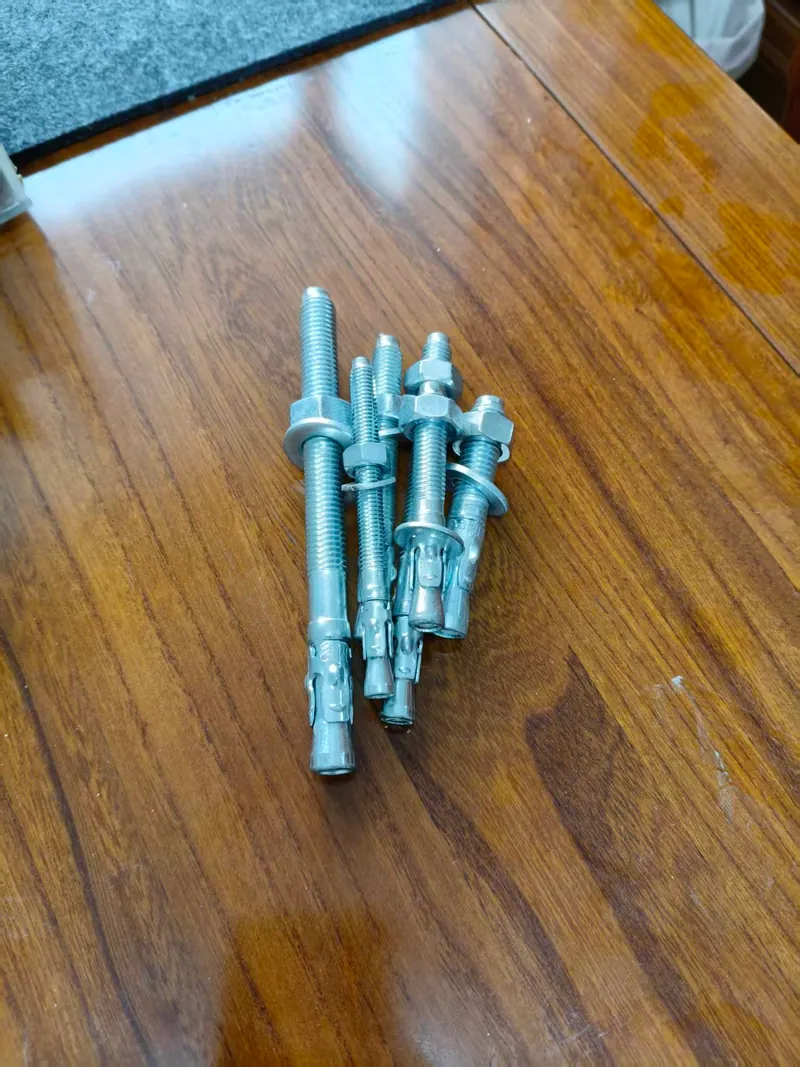
Embedment depth — how far the anchor sits in the concrete — decides whether the concrete cone around it can develop full strength. The working rule is a minimum embedment of about four to five times the anchor diameter in sound, normal-weight concrete, deeper for critical loads. The wedge clip at the anchor's lower end must be fully inside sound concrete, below any weak surface layer or topping screed; measure embedment from the concrete surface, not from the top of the fixture. If the slab is thin, check the required depth against the slab thickness before ordering — an anchor that nearly punches through the slab is a failed design, and no diameter upgrade fixes it.
Concrete condition, edge distance and spacing
Concrete condition comes next. Published capacities assume sound, normal-weight concrete of a stated strength; cracked concrete, lightweight concrete, hollow block and old deteriorated slabs all reduce holding power, and some call for a different anchor type entirely. Edge distance and spacing are the geometry checks: keep anchors well back from free edges — a common minimum is on the order of ten diameters, tightened by the project engineer — because concrete near an edge breaks out in a cone rather than holding. Space multiple anchors so their cones do not overlap and steal capacity from each other. When anchors must sit close to an edge or to each other, that is a design question for the engineer, not a field adjustment.
Finish and final checks before you order
Finish is the durability decision. Zinc-plated wedge anchors suit dry indoor concrete; for outdoor, damp or corrosive exposure, hot-dip galvanized anchors are the catalog answer — the thick zinc layer survives weather that would consume thin plating. Before ordering, confirm five lines on the inquiry: diameter, length (which follows from fixture thickness plus embedment), concrete strength and condition, minimum edge distances on the drawing, and finish. Send those to WTFasteners — Hebei W.T Fasteners Co., Ltd., a source factory in Yongnian, Handan, China — at WhatsApp +86 138 0310 6448 or postmaster@wtfastener.com, and the anchor is quoted factory-direct against the catalog specification. See the full range on the anchors page.
Have a specification to source?
Send the standard, drawing or sample details to route your inquiry.